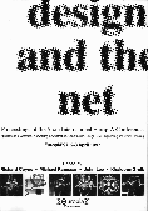
Design and the Net
R. COYNE, M. RAMSCAR,
J. LEE, K. ZREIK
Proceedings of Europia'97
ISBN 2-909285-07-3 ,
342 Pages - Prix 38,11 euros

Introduction
Ten years ago few would
have anticipated the emergence and prominence of the global hypertext
linkup that is the World Wide Web. The configuration and content
of nodes and links of the global network is constantly re-forming,
but the net is also changing in character. An archaeology of
the net reveals the original substrate of the Internet founded
on the necessity for fast and reliable data exchange. The rich
work environment of the researcher and academic lies above this.
Above is the playground for the hacker and computer addict. Then
we see the network of conduits through which individuals channel
their intimate thoughts to the world using the medium of the
personal web page. Now there is the net as a market place with
its own emerging economy and methods of exchange. The net is
also changing from a forum for unbridled access as people decide
what to make public, what to conceal, and what new channels to
plough through the old. The web appears as fluid and labyrinthine
as the network of metaphors used to describe it. There has been
much groundwork, but design applications on the net are in their
infancy. The papers for this conference are bursting with anticipation,
capturing the tenor of this changing environment. Papers cover
emerging applications, including the distribution of CAD and
other library information, three dimensional models on the Web,
information systems, and distributed management systems. Many
of the experiments take place in the context of education, as
this is where the net finds ready applicability, and it is most
widely available for experimentation by researchers and academics.
Contributors to this conference also consider the emerging web
culture, and the new ways of working brought about by the net,
taking account of a spectrum of tools and devices, from the simple
use of email, to Java applications, to high quality synchronous
video. The computer-aided design research community has been
considering the issues raised by the current state of the net
for many years, and many have been working on the issues of data
exchange, representation, human-machine interaction, fast and
meaningful data access, the integration of mixed media, collaborative
systems, and smart programs. But the new forms of the net seem
to have cast these issues in a new light, and rendered their
resolution more urgent, or obsolete in some cases. You will find
that the authors of these proceedings provide a stimulating contribution
to our understanding of design and the net. In total, the proceedings
indicate many important areas in need of concerted research effort.

Sommaire / Contents
Working with the web:
Networked applications
Common libraries for
networked engineering applications.
R. Tuttle, B. Regli,
G. Little, D.E.R. Clark and J. Corney
The VRML model of
the city of Bath
V. Bourdakis and A. Day
An integrated traffic
information system.
T. Preuss and J.-H. Syrbe
Shared information
system for urban and architectural design
L. Caneparo
Communication in distributed
statistical frameworks for historic building documentation: The
Abbey of Valmagne
R. Warden and G. Vasquez
de Velasco
CAD On-line
R. D. Coyne and J. Lee
Working with the web:
Innovation and technology
A method for organising
and sharing architectural project information in the WWW
S. Ofluoglu and L. N.
Kalisperis.
Designing learning
environments using java.
K. W. Pang and E. A.
Edmonds
A web-based design
support environment for knowledge discovery and machine learning
C. Branki, A. Bridges,
A. Wallis and I. Aird
Ways of aiding navigation
in VRML worlds.
D. Charitos and P. Rutherford
Multilevel representations
of architectural designs
A. Koutamanis
e-maill@simultaneous.design
: A network aid for design project management
A. Roussel and K. Zreik
The web in practice:
Education in cyberspace
The tex-mex virtual
design studio.
G. Vasquez de Velasco
and J.J. Trigo
Networked based decision
support for building design
M. Burry and M. Smithers
Digital design: students
communicating experiential spatial qualities in a networked computing
environment
J.B. Burley, D. Megza
and A. Bauer
The web in practice:
The emerging webculture
HQ video conferencing
and its application to the teaching of architecture.
M. Lindsay and M. Grant
Sedimented practices
of `reading' design descriptions: from paper to screen.
C. Tweed
The architect's role
in the information age.
N. Rossis
Collaborative design
by discovery and the web.
C. Peng
Method DTN: Design
on the net.
Y. Reze
A cyberspace in time.
P. Szalapaj and J. C.
Filho
A virtual monoculture
of visual communication.
S. Newton and J. Shi
Design, information
and the superhighway: roadworks ahead?
M. Ramscar and J. Lee